

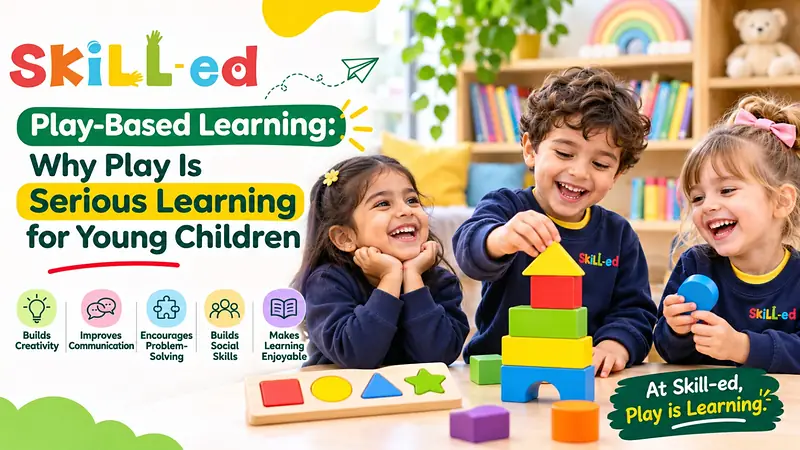
Have you ever seen how kids can spend hours building skyscrapers with blocks, pretending to run a restaurant or investigating everything around them without getting bored? To an adult, it may look like simple play, but for a child it is a crucial part of learning and growth.
Play is about much more than entertainment for young children. It is one of the most natural ways of making sense of the environment, learning new skills and understanding everyday experiences. Children are learning all the time through these tiny but meaningful activities, whether they are solving a problem, playing with friends, creating something with colours or pretending to be a doctor.
This is the principle underlying play-based learning, a strategy that makes education fun, participatory and meaningful for young students.
When parents are looking for the appropriate preschool in Dehradun, they usually opt for a school that provides outstanding teaching, a loving environment and possibilities for their children to flourish. However, one key thing parents should also evaluate is how the institution handles early childhood education. A learning environment that promotes exploration, creativity and hands-on activities can make a positive difference in a child's early years.
At Skill-ed School, Dehradun, we feel that children learn best when they are interested in finding things around them. Play is not separate from school for us, but is a vital aspect of the educational process.
What Is Play-Based Learning?
Play-based learning is an educational approach in which children develop knowledge and skills through enjoyable, engaging and purposeful activities.
Instead of relying only on textbooks, worksheets or memorisation, children are encouraged to learn by doing. Activities such as storytelling, building blocks, role play, art and craft, music, sensory exploration and outdoor games introduce children to different concepts in a natural way.
For example, when children play with building blocks, they are not just stacking objects. They are learning about shapes, sizes, balance, patterns and problem-solving. Similarly, when they participate in pretend play, they develop language skills, imagination and an understanding of different social situations.
This approach makes learning easier to understand because children can connect new concepts with their own experiences.
How Does Play-Based Learning Help Children Develop?
Play contributes to several areas of early childhood development. It helps children grow academically, socially, emotionally and creatively while allowing them to enjoy their learning experiences.
1. Encourages Creativity and Imagination
Children have a naturally lively imagination. Give them some building blocks, some colours or simple toys and they can make a whole new universe.
Creative activities such as sketching, painting, storytelling and pretend play enable children to express their thoughts and to explore numerous possibilities. They learn that there can be more than one method to do a task or solve a problem.
For example, a child playing shopkeeper can set up a little shop, display toys as products and deal with friends as customers. This simple task helps to foster imagination, decision making and creative thinking.
A healthy preschool setting allows children enough latitude to explore their ideas rather than require them to follow the same instructions all the time.
2. Improves Communication and Language Skills
Learning to communicate is one of the most important milestones in early childhood. Play provides children with regular opportunities to listen, speak, ask questions and express their thoughts.
Activities such as group storytelling, role play, rhymes and interactive games introduce children to new words and expressions.
When children play together, they naturally learn how to explain their ideas, respond to others and participate in conversations. Even simple activities such as playing with toy animals or pretending to cook can encourage meaningful communication.
These everyday interactions gradually help children become more comfortable expressing themselves in different situations.
3. Develops Problem-Solving and Critical-Thinking Abilities
Children often face small challenges while playing. A puzzle piece may not fit, a block tower may fall, or they may need to figure out how to complete a particular activity.
These situations encourage them to observe, think and try different solutions.
Instead of immediately providing answers, teachers can guide children with simple questions that encourage independent thinking. This allows young learners to develop patience, curiosity and problem-solving abilities.
Activities such as sorting objects, matching shapes, solving puzzles and building structures introduce basic reasoning skills in an enjoyable manner.
These early experiences help children become more confident in approaching new challenges.
4. Builds Social Skills and Emotional Understanding
Social development of a child starts with everyday encounters. Playing with other kids provides crucial things that books can't always provide.
Group activities teach children how to share toys, wait for their turn, follow simple rules and co-operate with others. They also start to realise that various people can have different thoughts and sentiments.
Kids may have a disagreement sometimes while playing. Under the gentle guidance of teachers, children progressively learn how to deal with unpleasant situations, express their feelings and build empathy.
These experiences allow kids to make friends and be more comfortable in social situations.
5. Supports Physical Development and Coordination
Play also plays an important role in developing a child's physical abilities.
Activities such as running, jumping, dancing, balancing and outdoor games help improve gross motor skills. Meanwhile, drawing, colouring, clay modelling, puzzles and handling small objects support fine motor development.
These activities strengthen hand-eye coordination, body balance and muscle control.
Regular opportunities for movement and hands-on exploration help children become more aware of their bodies while making physical development an enjoyable experience.
6. Makes Learning More Enjoyable and Meaningful
Small children are inherently curious, yet they might get bored if education is repetitious or too regimented.
Play-based activities make learning more participatory since children are allowed to see, touch, explore and experience diverse concepts.
For example, when children combine paints, learning about colours becomes more engaging; and when they count toys or arrange objects, knowing numbers gets easier.
Children are more likely to participate actively, to retain what they have experienced and to have a positive attitude towards learning when they like an activity.
That's why play-based learning is such a vital part of quality early childhood education.
What Should Parents Look for in a Preschool?
Choosing the right preschool is an important decision because a child's first school experience can influence their attitude towards education.
If you are searching online for a preschool near me, do not focus only on distance, infrastructure or facilities. Try to understand how the school supports children's everyday learning and development.
Here are a few things worth considering:
- Learning Approach: Look for a school that encourages play-based and experiential learning instead of depending only on memorisation.
- Teacher Interaction: Teachers should be patient, supportive and attentive to each child's individual needs.
- Creative Activities: Art, music, storytelling, outdoor play and hands-on experiences should be part of the learning routine.
- Social Development: Children should get opportunities to interact, participate in group activities and develop friendships.
- Safe Environment: A welcoming, hygienic and supportive atmosphere helps children feel comfortable and confident.
The right preschool should make children excited about coming to school and discovering something new every day.
Learning Through Experiences at Skill-ed School, Dehradun
We at Skill-ed School, Dehradun, believe that any small activity may be turned into a great learning opportunity.
We focus on play-based pedagogy, experiential learning and child-centred experiences. We encourage children to explore their environment, ask questions, play with ideas and discover new things at their own speed.
From sensory exploration and storytelling to pretend play, creative activities, outdoor excursions and hands-on experiments, children get chances to learn outside typical classroom techniques.
We recognise that every child is unique. Some kids love to be creative, some like to explore objects, ask questions or play group games. We want to establish a climate in which each child is encouraged to take part and to express him or herself.
Skill-ed School is a school for children from Playgroup to Grade 2. The focus is on making the early educational experience fun, engaging and meaningful.
For parents seeking a preschool in Dehradun that promotes curiosity, creativity and general child development, understanding a school's teaching philosophy is a vital first step.
Conclusion: At Skill-ed School, Play Is Learning
Childhood should be a time of exploration, imagination, experimentation and discovery. Every game, narrative, creative activity, and small encounter in the classroom can teach children something significant.
Play-based learning allows young children to develop creativity, communication, confidence, social understanding and problem-solving skills. More importantly, it lets students enjoy the learning process without undue strain.
Parents need to realise that while selecting a preschool, early education is more than simply preparing children for the next grade. It's about helping kids build the skills, confidence and curiosity they will take with them throughout life.
At Skill-ed School, Dehradun, we think that play is an integral part of learning. Play is a form of learning.